Excerpt
…An arbitrary claim is one for which there is no evidence, either perceptual or conceptual. It is a brazen assertion, based neither on direct observation nor on any attempted logical inference therefrom. For example, a man tells you that the soul survives the death of the body; or that your fate will be determined by your birth on the cusp of Capricorn and Aquarius; or that he has a sixth sense which surpasses your five; or that a convention of gremlins is studying Hegel’s Logic on the planet Venus. If you ask him “Why?” he offers no argument. “I can’t prove any of these statements,” he admits — “but you can’t disprove them, either.”
The answer to all such statements, according to Objectivism, is: an arbitrary claim is automatically invalidated. The rational response to such a claim is to…
Excerpt
The moral justification of capitalism is not that it serves the public. Capitalism does achieve the “public good” (appropriately defined), but this is an effect, not a cause; it is a secondary consequence, not an evaluative primary. The justification of capitalism is that it is the system which implements a scientific code of morality; i.e., which recognizes man’s metaphysical nature and needs; i.e., which is based on reason and reality. A secondary consequence of such a system is that any group who lives under it and acts properly has to benefit.
The distinction between primary and secondary — in other words, one’s hierarchy of values — is critical here, as it is throughout the realm of evaluation. A simple example is furnished by a man swimming in a lake. If reaching a distant shore is his evaluative primary and swimming is merely a means to it, the man will husband his energy, take periodic rests, move in a straight line, keep his body as tranquil as he can; he will do what he must to reach his goal, but no more — especially if he is a reluctant swimmer, who generally shuns the activity. But if he is primarily interested in the swimming, if his motive, say, is aerobic exercise and reaching the shore is merely a result (albeit an imperative one), he will go out of his way, other things equal, to expend energy, avoid rests, swim in zigzag fashion, make his heart pound fiercely. One’s priorities make a difference; they may drastically affect one’s behavior even in regard to enacting the same causal sequence. Assuming that there is any room in which to maneuver, one’s primary value in a given context is the thing one will focus on, emphasize, lionize.
From Adam Smith to the present, the value standard upheld by capitalism’s champions has been the “public good.” Individual freedom has been defended either as an ethically neutral means to this end (a common Enlightenment attitude) or, after Kant, as a necessary evil. Capitalism’s virtue, in this interpretation, is that it converts the amorality of “prudence” or the wickedness of greed into the nobility of social work. Men who hold this viewpoint, like the reluctant swimmer, are impelled to minimize one aspect of the causal sequence they uphold here and to emphasize the other. They minimize the individualist cause and emphasize the social effect, which, to them, is the moral primary. Thus they find themselves drawn irresistibly to compromise, cutting back one step at a time on the element they regard as neutral or worse, allowing “some controls” and then more and still more…
Excerpt
…A man does not know everything, but he does know what he knows. The choice is not: to make unwarranted, dogmatic claims or to give up the cognitive quest in despair. Both these policies stem from the notion that omniscience is the standard. One side then pretends to have access to it somehow, while the other bewails our lack of such access. In reason, however, this kind of standard must be rejected. Conceptual knowledge rests on logic within a context, not on omniscience. If an idea has been logically proved, then it is valid and it is an absolute — contextually. This last term, indeed, does not introduce a factor distinct from logic and should not have to be stressed: to adduce evidence for a conclusion is to place it within a context and thereby to define precisely the conditions of its applicability.
Many people in our Kantian era think, mistakenly, that absolutism is incompatible with a contextual approach to knowledge. These people define an “absolute” as a principle independent of any other fact or cognition; i.e., as something unaffected by anything else in reality or in human knowledge. Such a principle could come to be known only by revelation. An eloquent example of this approach was offered years ago by a famous relativist, who told his class that airplanes refute the law of gravitation. Gravitation, he explained, means that entities over a certain weight fall to the earth; but an airplane in flight does not. Someone objected that there are many interacting factors in reality, and that gravitation involves an object’s falling only if the gravitational pull is not counteracted by an opposing force, as it is in the airplane’s case. To which the professor replied: “Precisely. Gravitation is conditional; its operation depends on circumstances; so it is not an absolute.” What then would qualify as an absolute? Only a fact that has no relationships to anything (like Hegel’s supernatural Absolute). Such a fact would be knowable only “in itself,” by mystic insight, without the “contamination” of any “external” context of evidence.
The modern definition of “absolute” represents the rejection of a rational metaphysics and epistemology. It is the inversion of a crucial truth.
Excerpt
At this stage, I want merely to dissociate Ayn Rand’s approach from the subjectivist idea of dealing with others. Egoism, in the Objectivist interpretation, does not mean the policy of violating the rights, moral or political, of others in order to satisfy one’s own needs or desires. It does not mean the policy of a brute, a con man, or a beggar. It does not mean the policy of turning other men, whether by clubs or tears, into one’s servants. Any such policy, as we will see in due course, is destructive not only to the victim, but also to the perpetrator. It is condemned as immoral, therefore, by the very principle of selfishness.
The best formulation of the Objectivist view in this issue is the oath taken by John Galt, the hero of Atlas Shrugged. “I swear — by my life and my love of it — that I will never live for the sake of another man, nor ask another man to live for mine.” The principle embodied in this oath is that human sacrifice is evil no matter who its beneficiary is, whether you sacrifice yourself to others or others to yourself. Man — every man — is an end in himself.
If a person rejects this principle, it makes little difference which of its negations he adopts — whether he says “Sacrifice yourself to others” (the ethics of altruism) or “Sacrifice others to yourself” (the subjectivist version of egoism). In either case, he holds that human existence requires martyrs; that some men are mere means to the ends of others; that somebody’s throat must be cut. The only question then is: your life for their sake or theirs for yours? This question does not represent a dispute about a moral principle. It is nothing but a haggling over victims by two camps who share the same principle.
Objectivism does not share it. We hold that man’s life is incompatible with sacrifice — with sacrifice as such, of anybody to anybody. We reject both the above theories on the same ground. As Ayn Rand states the point in The Fountainhead, the rational man rejects masochism and sadism, submission and domination, the making of sacrifices and the collecting of them. What he upholds and creates is…
Excerpt
We are often told that love (like the pursuit of truth) is selfless. A “selfless love” would be one unrelated to the lover’s own life, judgment, or happiness; such a thing defies the very nature of love. “A ‘selfless,’ ‘disinterested’ love,” writes Ayn Rand, “is a contradiction in terms: it means that one is indifferent to that which one values.” Here again the truth is the opposite of the conventional idea. The egoist is not a man incapable of love; he is the only man capable of it. “To say ‘I love you,’ “as Howard Roark observes, “one must know first how to say the ‘I.’ “
Excerpt
The “profit motive,” speaking broadly, means a man’s incentive to work in order to gain something for himself — in economic terms, to make money. By Objectivist standards, such a motive, being thoroughly just, is profoundly moral. Socialists used to speak of “production for use” as against “production for profit.” What they meant and wanted was: “production by one man for the unearned use of another.”
In a specialized sense, “profit” means…
Excerpt
“Capitalism,” in Ayn Rand’s definition, “is a social system based on the recognition of individual rights, including property rights, in which all property is privately owned.” This is a definition in terms of fundamentals and not of consequences. “Capitalism,” by contrast, may not be defined as “the system of competition.” Competition (for power and even for wealth) exists in most societies, including totalitarian ones. Capitalism does involve a unique form of competition, along with many other desirable social features. But all of them flow from a single root cause…
Excerpt
This brings me to another topic: to an alleged opposite of statism that, in fact, entails it. I mean anarchism.
Anarchism is the idea that there should be no government. In Objectivist terms, this amounts to the view that every man should defend himself by using physical force against others whenever he feels like it, with no objective standards of justice, crime, or proof.
“What if an individual does not want to delegate his right of self-defense?” the anarchist frequently asks. “Isn’t that a legitimate aspect of ‘freedom’?” The question implies that a “free man” is one with the right to enact his desire, any desire, simply because it is his desire, including the desire to use force. This means the equation of “freedom” with whim-worship. Philosophically, the underlying premise is subjectivism (of the personal variety).
The citizens of a proper society should reply to such a subjectivist as follows…
Excerpt
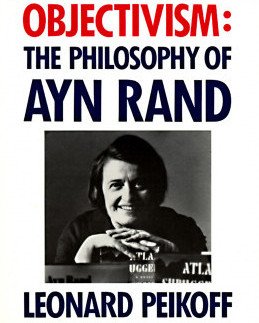
A brief excerpt from Leonard Peikoff’s Objectivism: The Philosophy of Ayn Rand
The fact that a man’s sex life is shaped by his conclusions and value-judgments is evident in every aspect. It is evident in the setting he prefers, the state of dress, the caresses, positions, and practices, and the kind of partner. This last is particularly eloquent.
No man desires everyone on earth. Each has some requirements in this regard, however contradictory or unidentified — and the rational man’s requirements, here as elsewhere, are the opposite of contradictory. He desires only a woman he can admire, a woman who (to his knowledge) shares his moral standards, his self-esteem, and his view of life. Only with such a partner can he experience the reality of the values he is seeking to celebrate, including his own value. The same kind of sexual selectivity is exercised by a rational woman. This is why Roark is attracted only to a heroine like Dominique, and why Dagny Taggart in Atlas Shrugged is desperate to sleep with John Galt, not with Wesley Mouch. Romantic love is the strongest positive emotion possible between two individuals. Its experience, therefore, so far from being an animal reaction, is a self-revelation: the values giving rise to this kind of response must be one’s most intensely held and personal.
When a man and woman do fall in love — assuming that each is romantically free and the context otherwise appropriate — sex is a necessary and proper expression of their feeling for each other. “Platonic love” under such circumstances would be a vice, a breach of integrity. Sex is to love what action is to thought, possession to evaluation, body to soul. “We live in our minds,” Roark observes, “and existence is the attempt to bring that life into physical reality, to state it in gesture and form.” Sex is the preeminent form of bringing love into physical reality.
The subject of sex is complex and belongs largely to the science of psychology. I asked Ayn Rand once what philosophy specifically has to say on the subject. She answered…
Excerpt
EMOTIONS AS DISTINGUISHED FROM SENSATIONS
…Emotions are states of consciousness with bodily accompaniments and with spiritual — intellectual — causes. This last factor is the basis for distinguishing “emotion” from “sensation.” A sensation is an experience transmitted by purely physical means; it is independent of a person’s ideas. Touch a man with a red-hot poker, and he unavoidably feels certain sensations — heat, pressure, pain — regardless of whether he is a savage or a sophisticate, an Objectivist or a mystic. By contrast, love, desire, fear, anger, joy are not simply products of physical stimuli. They depend on the content of the mind…
…When, as a college teacher, I would reach the topic of emotions in class, my standard procedure was to open the desk, take out a stack of examination booklets, and, without any explanations, start distributing them. Consternation invariably broke loose, with cries such as “You never said we were having a test today!” and “It isn’t fair!” Whereupon I would take back the booklets and ask: “How many can explain the emotion that just swept over you? Is it an inexplicable primary, a quirk of your glands, a message from God or the id?” The answer was obvious. The booklets, to most of them, meant failure on an exam, a lower grade in the course, a blot on their transcript, i.e., bad news. On this one example, even the dullest students grasped with alacrity that emotions do have causes and that their causes are the things men think. (The auditors in the room, who do not write exams, remained calm during this experiment. To them, the surprise involved no negative value-judgment.)…
CONFLICTS BETWEEN THOUGHTS AND FEELINGS
…What makes emotions incomprehensible to many people is the fact that their ideas are not only largely subconscious, but also inconsistent. Men have the ability to accept contradictions without knowing it. This leads to the appearance of a conflict between thought and feelings.
EMOTIONALISM
Objectivism is not against emotions, but emotionalism. Ayn Rand’s concern is not to uphold stoicism or abet repression, but to identify a division of mental labor. There is nothing wrong with feeling that follows from an act of thought; this is the natural and proper human pattern. There is everything wrong with feeling that seeks to replace thought, by usurping its function.
If an individual experiences a clash between feeling and thought, he should not ignore his feelings. He should…